
CULCORC Newsletter | September 2026
Updates on the CULCORC activities, including highlights since the last issue of the CULCORC Newsletter
Message from the CULCORC director
Welcome to our September 2026 CULCORC newsletter. It is surprisingly long, but I hope a little bit of scrolling will bring you to a publication or event that you will find interesting and relevant. Of course, there is no good reason to complain about the length of this newsletter, as it bears witness of the high levels of academic activity in CULCORC, but also of our ambition to continue reaching out to broader society, also deploying less traditional modes of academic communication. Three particular events deserve a special mention here: CULCORC had significant representations at the IAMCR conference in Galway, and at the ECREA conference in Brno. These conferences were not only important opportunities to communicate our work, but offered also nice opportunities for our get-togethers. Thirdly, Vaia Doudaki and her team organised the successful “Communicating narratives, imaginaries and epistemes of hope” event on 7 September 2026, which was a joint Communication, Social Justice and Democracy IAMCR Working Group conference and ECREA 2026 pre-conference. You will find more about these events, and much more about other activities below.Enjoy the read!
Nico Carpentier, Director of CULCORC
TABLE OF CONTENTS
- Research Highlights
- Articles and Chapters
- Upcoming Publication
- Reviews
- Events
- Project Updates
- Screenings
- Upcoming Events
- CULCORC in Media
- Stay Connected
RESEARCH HIGHLIGHTS
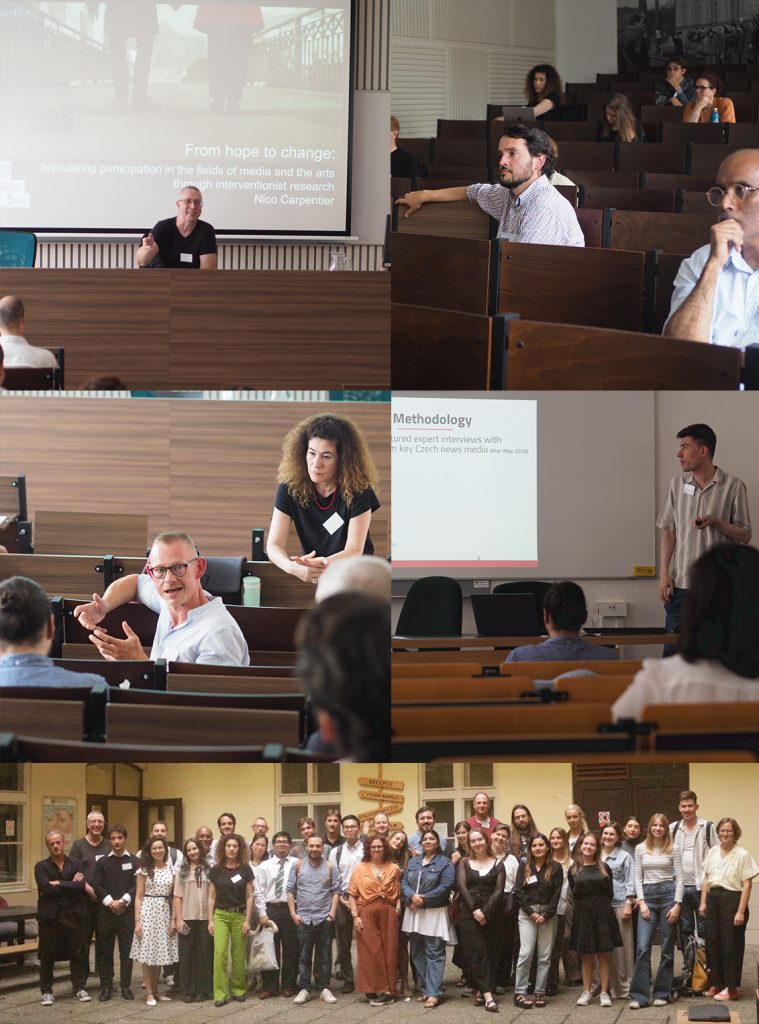
1. HOPE: IAMCR Joint Communication, Social Justice and Democracy Working Group Conference & ECREA 2026 Pre-Conference (Prague, Sep 7, 2026)
Hosted by CULCORC and ICSJ at Charles University, the conference explored hope, change, and critique in communication, media, and the arts. It also included keynotes by Ilija Tomanić Trivundža and Nico Carpentier.
See more on the IAMCR website.
2. MeDeMAP Special Issue: “Citizens’ Perceptions of Media and Democracy across Europe” (ESSACHESS, Jun 29, 2026)
A special issue of ESSACHESS, Journal for Communication Studies, bringing together MeDeMAP research on citizens’ perceptions of media, trust, democracy, and political participation across Europe.
Read the special issue on ESSACHESS webpage.
Image from CICANT

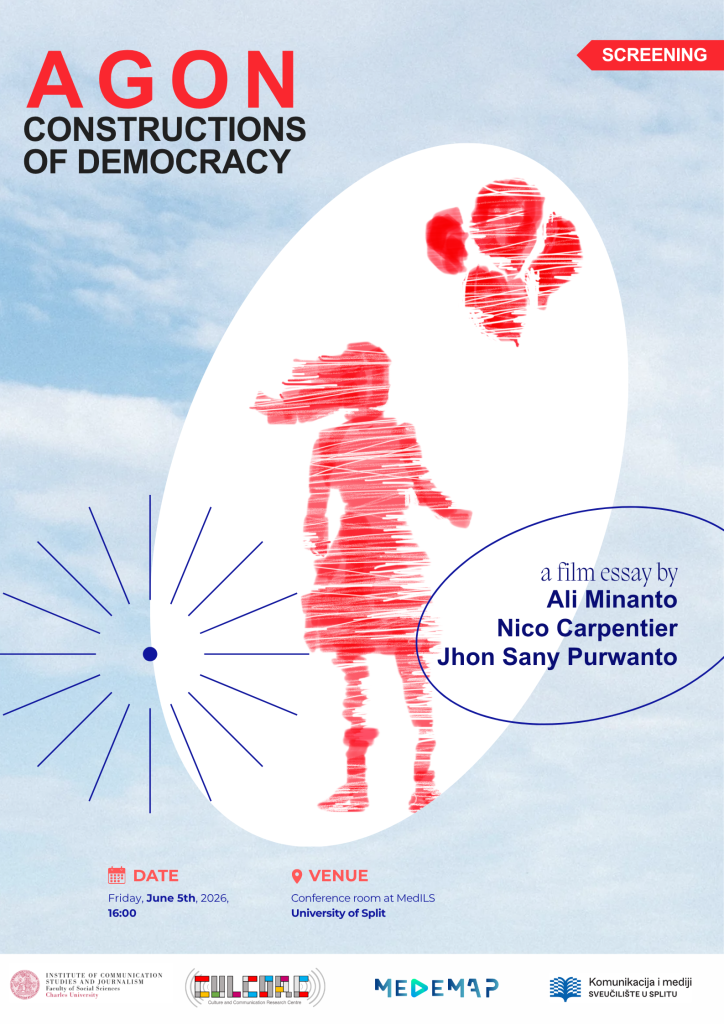
3. AGON: Constructions of Democracy Screening at Communication and Media Days (Split, Jun 5, 2026)
A screening of AGON: Constructions of Democracy at the University of Split invited audiences to reflect on democracy, participation, and the relationship between academic and artistic approaches.
See more on the University of Split website.
4. Eight CULCORC member presentations at the 11th European Communication Conference in Brno, Czech Republic (8-11 September 2026) & seven CULCORC member presentations at the IAMCR conference in Galway, Ireland (28 June – 2 July 2026).
CULCORC members participated in the IAMCR Conference in Galway, Ireland, and the 11th European Communication Conference in Brno, Czech Republic by delivering a number of presentations on topics ranging from constructions of nature, peace, conflict, to constructions of childhood, and many more.
See more on the CULCORC website.

THINKING – Theory, Conceptual & Empirical Work
Articles and Chapters
(Post-) Digital Transformation of Rupture: The Czech Media Landscape and its Threats
By Karolina Šimková and Jeffrey Wimmer
AoIR Selected Papers of Internet Research: Read here
This study examines discursive and material threats to Czech media and democracy through interviews. Within their findings, they argue that the material and discursive implications of datafication have become crucial for understanding the rupture between media and democracy.
Breaking the Mold: How the Rodin Museum Became France’s Most Financially Autonomous Cultural Institution
By Philippe Ravanas and Sandra Kumorowski
International Journal of Arts Management: Read here
This teaching case examines the Rodin Museum’s financially sustainable model, combining public ownership, entrepreneurial legacy, diversified revenues, strategic pricing, and governance, while addressing challenges around accessibility, international partnerships, and reproduction rights.
University students’ perspectives and (re-)imaginations of inclusive classroom practices. An inclusive and collaborative approach to inclusive education
By David Ongenaert, Anna Rönsch and Natalia Koenig
International Journal of Inclusive Education: Read here
This study examines students’ perspectives on inclusive education at a Dutch university, using participatory research and visual ethnography to identify six interconnected practices supporting engagement, collaboration, belonging, diversity, and varied assessment.
Constructing the Discursive Frontiers: A Discourse-Theoretical Analysis of the Blue Homeland Doctrine in a TRT Documentary
By Mazlum Kemal Dağdelen
Monitor ISH, Journal for the Humanities and Social Sciences: Read here
The article examines how Turkey’s maritime borders are discursively constructed through the ‘Mavi Vatan’ (Blue Homeland) doctrine. By analysing a TRT documentary and its audience reception, the study shows how media narratives mobilise notions of homeland, justice, and power to shape national identity, legitimise territorial claims, and construct political antagonisms.
Constructing childhood in the Russian-Ukrainian War: UNICEF’s Instagram representations of children
By Marie Flügge and David Ongenaert
Media, War & Conflict: Read here
This study analyses UNICEF’s Instagram representations of children affected by the Russia–Ukraine war, revealing a shift from vulnerable “ideal victims” toward resilience while traditional humanitarian imagery remained dominant.
Assemblages of Trust: A Discursive-Material Analysis of Czech Citizens’ Perceptions of Media and Democracy
By Karolína Šimková and Jeffrey Wimmer
ESSACHESS, Journal for Communication Studies: Read here
This study explores media and democratic trust in the Czech Republic, showing how discursive interpretations, material inequalities, media structures, and everyday experiences shape trust as a situated practice.
MeDeMAP Special Issue: “Citizens’ Perceptions of Media and Democracy across Europe”
With articles by Elisabetta Risi, Giulia Ferri, Andrea Miconi, Brankica Petković, Mojca Pajnik, Nuno Cintra Torres, Tatiana Chervykova, Manuel José Damásio, Morgane Le Guyader, Inna Lyubareva, Romain Billot, Karolína Šimková, Jeffrey Wimmer, Kristiina Raud, Alessandro Nanì, Maren Beaufort, Reem Al-Zou’Bi, Anas Moutia, Rangga Galura Gumelar, Iman Mukhroman, Daffa Leroy Galura Gumelar and Nicu Gavriluta.
ESSACHESS, Journal for Communication Studies: Read here
This collection brings together research from the MeDeMAP project, exploring how citizens across Europe perceive media, trust, democracy, and political participation in today’s evolving information environments.
“It is About Solidarity. It is About Being Part of a Community, However Diverse That Community May Be”: Interview with Nico Carpentier
By Fernando Oliveira Paulino and Nico Carpentier
Journal of Latin American Communication Research: Read here
The interview with Nico Carpentier examines academic cooperation, international networks, and solidarity in communication studies, addressing epistemic inequalities, multilingualism, academic precarity, and freedom while highlighting plural, collaborative approaches to knowledge production.
Introduction to the Special Issue ‘Transnational Families and Media Practices: Methods, Ethics and Critical Approaches’
By Anastassia Zabrodskaja, Silvia Almenara-Niebla, Mélodine Sommier, David Ongenaert and Sara Marino
Journal of Global Diaspora & Media: Read here
The publication builds on the European Communication Research and Education Association (ECREA) DMM-IIC conference on “Transnational Families and Media Practices”, organised in Rotterdam in 2023. The special issue extends the conversations initiated at the conference by exploring how transnational families experience, imagine, and reproduce cross-border lives through media and communication.
Upcoming Publication
Assembling Nature: Discursive-Material Struggles between Anthropocentrism and Ecocentrism
By Nico Carpentier, Vaia Doudaki and Kirill Filimonov
Intellect Books
Coming out in Fall 2027: Read more on the CULCORC website
The upcoming book by Nico Carpentier, Vaia Doudaki and Kirill Filimonov, to be published by Intellect Books in autumn 2027, examines discursive-material struggles over the environment and human–nature relationships. Based on an extensive mapping project and eight case studies across media and art, the book explores the role of anthropocentric and ecocentric assemblages in these struggles.
Reviews
Book review: N. Carpentier and J. Wimmer, Democracy and Media in Europe: A Discursive-Material Approach
By Xin Zhang (Jinan University, China)
Discourse & Society: Read here
The review highlights the book’s contribution to connecting discourse theory with the material organisation of media systems and democratic participation, moving beyond text-centred approaches. At the same time, its high level of abstraction and limited use of case studies may challenge some readers, suggesting the need for further empirical research.
Film review: AGON: Constructions of Democracy
By Martin Bubanović
Media Studies / Medijske studije: Read here
Along with the book “Democracy and media in Europe: A discursive-material approach” by Nico Carpentier and Jeffrey Wimmer, AGON brings together discourse theory and new materialist philosophy in an evocative framework of narration, fiction and dance, in order to explore the relationship between democracy, space and political struggle. In his review, Martin highlights that AGON is an invitation to consider what democracy is and what it can be, how it is linked to space, and how it is always a location of political struggle.
Book review: N. Carpentier and J. Wimmer, Democracy and Media in Europe: A Discursive-Material Approach
By Martin Bubanović
Alphaville – Journal of Film and Screen Media: Read here
The review discusses how this book provides a theoretical reflection on the intersection of democracy and media through a constructionist lens. Thus, the book theoretically supports the MeDeMAP project, which aims to set out future-proof pathways to strengthen democracy by improving the accountability, transparency, and effectiveness of media production and expanding active and inclusive citizenship.
ENGAGING – Dialogue with Academia & Civil Society
Events
Guest Lecture: “The changing role of media in a volatile democracy” (March 25, 2026)
Nico Carpentier delivered a guest lecture titled “The changing role of media in a volatile democracy” at Tallinn University’s Baltic Film, Media and Arts School (BFM) in Tallinn, Estonia. The lecture drew on the book Democracy and Media in Europe: A Discursive-Material Approach, co-authored by Nico Carpentier and Jeffrey Wimmer, and on research conducted within the MeDeMAP project, which addresses the changing role of media in contemporary democratic contexts.
See more on the CULCORC website
Conference Participation: “Performing the Digital Self: Poststructuralist and Feminist Perspectives on Gender Construction in Online Trends” (April 16, 2026)
Uxía Sánchez Lorda delivered this presentation at the I Female CorpoRealities International Conference, held at the University of Alcalá and organised by PANDORA Literary Gender Studies. She explored how post-structuralist approaches can offer a deep theoretical framework for digital analysis.
See more on the PLGS International Conference website
Keynote: “The Struggle over Participation: How to Rescue Participation and Empowerment from Emerging Media Practices and Critiques“ (April 17, 2026)
Nico Carpentier delivered a keynote at the SJTU-IAMCR Emerging Media Conference 2026, hosted by Shanghai Jiao Tong University and the International Association for Media and Communication Research (IAMCR). The keynote examined the tensions surrounding participation and empowerment in the context of emerging media practices and the debates surrounding them.
See more on the IAMCR website
Keynote: “Humanist ethics as resistance: An analysis of three mediated interventions that counter dehumanisation and disempowerment” (April 24, 2026)
Nico Carpentier took part as a keynote speaker, alongside Erika Darics, PhD (University of Groningen), at the 4th annual Corvinus Communication Conference (CoCoCo) at Corvinus University of Budapest, Hungary. Nico Carpentier’s keynote explored how mediated interventions can resist dehumanisation and disempowerment through humanist ethics, participation, and alternative forms of representation.
See more on the CoCoCo 2026 website
Study Visit at the University of Salzburg (May 16-20, 2026)
Elisabeth Wennerström completed a five-day study visit at Paris Lodron Universität Salzburg, where she served as a guest teacher for the courses “Information, Communication, and Trust” and “Introduction to Communication for Development” and presented her dissertation research at the KOWI Lunch Talks.
See more on CULCORC LinkedIn profile
Roundtable: “Democracy and Media in Europe: A Discursive-Material Approach. Discussion with Nico Carpentier and Jeffrey Wimmert” (June 5, 2026)
As part of the international conference ‘Communication and Media Days 2026’ at the University of Split, the discussion built on the open-access book ‘Democracy and Media in Europe: A Discursive-Material Approach’ (Routledge, 2025), and forms part of an international discussion series.
See more on the Komunikacija i mediji | Sveučilište u Splitu website
Academic Writers Retreat 2026, by Jönköping University in Gränna, Sweden (June 22-26, 2026)
Elisabeth Ulrika Wennerström and Štěpán Šanda participated in the Academic Writers Retreat hosted by Jönköping University in Gränna, Sweden. Led by renowned media scholars Annette Hill and Joke Hermes, the retreat invited participants to reflect on academic writing as a craft. Through workshops, peer feedback, dedicated writing time, and discussions in a peaceful setting overlooking Lake Vättern, participants explored new ways of developing their research and writing practices.
See more on the Jönköping University website
Participation in the ECREA European Media and Communication Doctoral Summer School 2026 (August 2–10, 2026)
Štěpán Šanda and Uxía Sánchez Lorda participated in the ECREA European Media and Communication Doctoral Summer School 2026, hosted by Södertörns högskola in Stockholm, Sweden. Bringing together around 50 doctoral researchers from more than 20 countries, the summer school provided an international environment for participants to present and discuss their doctoral research.
See more on the ECREA website
Panel discussion: Internationalisation and Academic Nationalism (September 14, 2026)
Organised by the Centre for Doctoral Studies of the Institute of Communication Studies and Journalism, Faculty of Social Sciences, Charles University, the panel discussion brought together Nico Carpentier, Vaia Doudaki, Robert Silverio (Charles University), Bart Cammaerts (The London School of Economics and Political Science (LSE) and Josef Seethaler (Austrian Academy of Sciences – Österreichische Akademie der Wissenschaften (ÖAW). They discussed the relationship between universities and their local contexts, as well as the international nature of academic research.
See more on the IKSŽ website
Participation in the Association for Media and Communication Research (IAMCR) Conference 2026, University of Galway (June 28 to July 2, 2026)
Conference Presentation: “Participation, Knowledge and Stupidity: A Theoretical Reflection”
By Nico Carpentier and Vaia Doudaki
Nico Carpentier with Aniruddha Jena, PhD (Indian Institute of Technology, Mandi), served as discussants in the panel “Participation, Knowledge and Communication: An Intersection of Transformative Forces”. At the same time, within the same panel, Nico Carpentier and Vaia Doudaki presented the paper: “Participation, Knowledge and Stupidity: A Theoretical Reflection”, contributing to ongoing discussions within the MeDeMAP project and broader debates on democracy, participation, and communication.
See more on CULCORC’s LinkedIn profile
Conference Presentation: “Constructing Turkishness in Cyprus: A Discourse-Theoretical Analysis of the Turkish Cypriot Children’s Magazines Published between the 1950s and 1980s”
By Mazlum Kemal Dağdelen
This presentation examined how notions of Turkishness were discursively constructed in Turkish Cypriot children’s magazines across several decades, exploring the intersections of identity, nationhood, and media culture.
See more on CULCORC’s LinkedIn profile
Conference Presentation: “Securitisation of Childhood: A Discourse-Theoretical Analysis of “Juvenile Delinquency Crisis” Debates on Ekşi Sözlük”
By Mazlum Kemal Dağdelen
In this presentation, Mazlum Kemal Dağdelen discussed analyses of how childhood and youth are constructed as objects of security concerns in contemporary digital public discourse, drawing on debates on the Turkish platform Ekşi Sözlük. Beyond his research presentations, Kemal also contributed to the conference programme through several organisational roles: Discussant of the panel HIS-Distinctive Media: Folk, Children’s, and Cultural Considerations; Panel Chair of CRI-Crisis Communication and Public Discussion; and Convenor of the CRI Book Launch Session and Crisis, Security and Conflict Communication Business Meeting.
See more on CULCORC’s LinkedIn profile
Conference Presentation: “Enactment of democracy in participatory deliberations: The case of the Czech Citizens’ Parliament on Media and Democracy”
By Vaia Doudaki, Nico Carpentier and Miloš Hroch
The presentation, developed within the MeDeMAP project, explored how democratic meanings are discursively constructed through participatory deliberative processes, based on the case of the Czech Citizen Parliament on Media and Democracy. The paper was presented within the panel: “CJD-5: Constructing Democracy: Deliberation, Contestation and Civic Praxis”, which was organised and chaired by Vaia Doudaki.
See more on CULCORC’s LinkedIn profile
Conference Presentation: “A Bogeyman in the Classroom: How Personal Digital Lives Shape Media Education in Czechia”
By Karolína Šimková
In her paper, Karolína Šimková discussed how online behaviours and digital habits affect how media literacy is taught and received in Czech classrooms. In addition to presenting her research, Karolína Šimková played an active organisational role within the Mediated Communication, Public Opinion and Society (MPS) Section, serving as: Panel Chair of MPS-12: Intergenerational Dynamics and Youth in the Digital Age; Panel Chair of MPS-14: Digital Harms, Moral Panics, and Algorithmic Precarity; and as Convenor of the MPS Section Business Meeting.
See more on CULCORC’s LinkedIn profile
Conference Presentation: “‘ICE Murdered Her’: A Discourse Theoretical Analysis of Queer Identities and Subject Position Articulations Within Autostraddle’s Coverage of U.S. State Intervention in Queer Communities (2016–2026)”
By Maedbh Pierce
Maedbh Pierce examined how the news and entertainment site Autostraddle constructed narratives of queer resistance. For the analysis, she used a Discourse-Theoretical Analysis as an analytical framework, based on Ernesto Laclau and Chantal Mouffe’s Discourse Theory.
See more on CULCORC’s LinkedIn profile
Conference Presentation: “Subjectivization of Czech Music Artists and Algorithmic Catching Up in the Global East”
By Miloš Hroch and Petr Szczepanik
Using insights from the political economy of global media and platform studies, the paper situated streaming platforms within the asymmetrical geographies of platform capitalism, where peripheral regions are more consumption markets than cultural centres.
See more on the CULCORC website
HOPE: IAMCR Joint Communication, Social Justice and Democracy Working Group conference & ECREA 2026 pre-conference “Communicating Narratives, Imaginaries and Epistemes of Hope” (CULCORC & ICSJ, Charles University, September 7, 2026)
Keynote session: Hope, change and critique
By Ilija Tomanić Trivundža and Nico Carpentier
Ilija Tomanić Trivundža (University of Ljubljana) presented “A non-paper on post-hope by the Ministry of High-Beam Headlights and Better Future of Cyber Yugoslavia”, questioning the linear relationship between hope and social change and proposing a critical reflection on what might lie beyond hope.
Nico Carpentier presented “From hope to change: Stimulating participation in the fields of media and the arts through interventionist research”, examining how hope can be translated into tangible social practice through participatory research in media policy and the arts. He used the MeDeMAP – Mapping Media for Future Democracies project and the analyses of the participatory arts project “Silencing and Un-Silencing the Landscape” as case studies in his talk.
See more on the IAMCR website
Conference presentation: “Hoping for bi+ self-determination: A discourse theoretical analysis of bisexual identity articulations in bi+ community media outlet ‘Bisexual Women Quarterly’”
By Maedbh Pierce
Her paper explored how bisexual community media can function as a site of hope, where marginalised voices reclaim their identities, build community and articulate aspirations for greater recognition and self-determination. This presentation took place within the session “(Youth) voices of hope: Digital media, civic imagination and identity”, chaired by Nico Carpentier.
See more on the IAMCR website
Conference presentation: “The ambivalent potential of hope: Hegemony, resistance, and the politics of femininity in #ThatGirl and #CleanGirlAesthetic online trends”
By Uxía Sánchez Lorda
Through her paper, Uxía Sánchez Lorda examined the ambivalent role of hope in contemporary social media constructions of femininity, showing how aspirational promises can reproduce hegemonic norms while also opening spaces for negotiation, resignification and resistance. This presentation took place within the session “(Youth) voices of hope: Digital media, civic imagination and identity”, chaired by Nico Carpentier.
See more on the IAMCR website
Conference presentation: “Holding hope by resistance in nature and culture articulations, highlighting Swedish environmental journalistic assemblages”
By Elisabeth Wennerström
Drawing on an analysis of more than 180 pieces of Swedish environmental journalism published between 2020 and 2025, Elisabeth Wennerström explored how hope emerges within the tensions between environmental crisis, resistance and despair.
See more on the IAMCR website
Conference presentation: “Street art and spaces of hope: Democratic contestation over urban space in Yogyakarta”
By Ali Minanto
Focusing on street art in post-Soeharto Indonesia, his research considered how artistic interventions can reclaim everyday urban spaces for political expression, participation and contestation. Street art thus becomes a means of making alternative voices visible and creating temporary spaces where different democratic possibilities can emerge.
See more on the IAMCR website
Conference presentation: “Curating hope: How do museums in petrostates envision a better future”
By Yaroslava Kutsai
Her study compared the Climate House in Oslo and the Museum of the Future in Dubai, examining how museums in oil-rich countries represent environmental futures. While these exhibitions offer optimistic visions of what lies ahead, Yaroslava also highlighted the need for more critical, ecocentric and justice-oriented imaginaries of environmental change.
See more on the IAMCR website
Conference presentation: “Peace as a discourse of hope? How journalists in the Czech Republic perceive and report on peace in the context of the Russian-Ukrainian war”
By David Ongenaert and Nico Carpentier
Based on 36 expert interviews with journalists from diverse key Czech news media, the research examined how peace is articulated in media coverage of the war. This presentation took place within the session “Politics and discourses of hope in peace and conflict,” which was also chaired by David Ongenaert.
See more on the IAMCR website
Conference presentation: “A new hope? Counterintuitive insights from a wide-scale research on political disillusion in Europe”
By Giulia Ferri and Andrea Miconi (IULM University)
Their presentation drew on research from the MeDeMAP – Mapping Media for Future Democracies project, based on 70 interviews and 40 focus groups across ten European countries.
See more on the IAMCR website
Conference presentation: “Knowing enough to hope: Media literacy and the unequal conditions of democratic imagination”
By Giulia Ferri (Università IULM, Italy)
Giulia Ferri presented research from the Horizon Europe MeDeMAP – Mapping Media for Future Democracies project, examining hope as an epistemic practice through which citizens navigate complex media environments, interpret information and maintain an orientation towards democratic futures.
See more on the IAMCR website
Conference presentation: “Pirate airwaves of hope: Protest broadcasting and the enactment of democratic hope in occupied Polytechneio”
By Vaia Doudaki
In her paper, Vaia Doudaki examined the short-lived illegal radio station operated by students during the occupation of the Polytechnic University of Athens in November 1973, under the Greek military dictatorship. This presentation took place during the session “Assemblages of hope: Media, protest and political imaginaries,” which was also chaired by Vaia.
See more on the IAMCR website
Participation in the 11th European Communication Conference (ECREA) 2026, Masaryk University, Brno, Czech Republic (September 8-11, 2026)
Conference presentation: “How peace is discursively constructed: A discourse-theoretical analysis of Russian and Ukrainian news agencies’ coverage”
By David Ongenaert and Nico Carpentier
They examined how the main Russian and Ukrainian state-owned news agencies construct peace in their coverage of the Russian-Ukrainian war. Using discourse-theoretical analysis, the analysed 495 news releases, including 221 images. The findings demonstrate the dominance of the strategic peace discourse across both agencies, despite distinct narratives and media systems.
See more on CULCORC’s LinkedIn profile
Conference presentation: “Spaceship Earth” or “the Womb”? How Museums in Petrostates Envision the Future in the Context of Climate Change”
By Yaroslava Kutsai
Yaroslava examined the Climate House in Oslo and the Dubai Museum of the Future, asking which environmental discourses prevail in these institutions and what kinds of futures they make appear realistic. Drawing on discourse-theoretical analysis, the study explored three environmental discourses (anthropocentric, ecocentric, and hybrid) alongside six future imaginaries, from techno-optimism and resilience to justice-oriented transformation and multispecies scenarios.
See more on CULCORC’s LinkedIn profile
Conference presentation: “Constructions of democracy in the Czech citizen parliament: Articulations and struggles”
By Vaia Doudaki, Nico Carpentier, and Miloš Hroch
The presentation examined how democracy was articulated and contested within the Czech citizen parliament (MeDeMAP – Mapping Media for Future Democracies), and it was part of the session “Media in the CEE Between Autocratic Attacks and Democratic Resistance.”
See more on CULCORC’s LinkedIn profile
Conference presentation: “The invisible rhizome: The characteristics, roles, and challenges of community media in Czechia”
By Karolína Šimková
Karolína Šimková presented a study conducted with Jeffrey Wimmer as part of the MeDeMAP project. In her talk, she highlighted the characteristics, democratic roles, and structural challenges of community media in Czechia, which represents a particularly instructive case given its lack of a formally recognised third media sector and a dedicated regulatory framework.
See more on CULCORC’s LinkedIn profile
Conference presentation: “The discursive constructions of nature and culture in Swedish environmental journalistic assemblages”
By Elisabeth Wennerström
In her presentation, Elisabeth focused on analysing articulations of nature and culture in Swedish environmental journalism and discussed related findings from her dissertation research. Her contribution was part of the session “Framing & Reporting The Environment.”
See more on CULCORC’s LinkedIn profile
Conference presentation: “Transcending anthropocentrism: A discourse-theoretical analysis of Moulding Nature’s communicative-artistic tactics”
By Nico Carpentier and Vaia Doudaki
The paper analysed the artworks presented in the “Moulding Nature” exhibition, examining how they relate to anthropocentric hegemonic and ecocentric counter-hegemonic discursive assemblages. At the same time, the study combines discourse theory, assemblage theory and critical environmental theory to focus on the discursive construction of human-nature relations.
See more on CULCORC’s LinkedIn profile
Conference presentation: “Negotiating female identity through collage creation in Ghana: A discourse-theoretical analysis and decolonial perspective”
By Lenka Marxová
In her presentation, Lenka Marxová presented the initial findings of a case study conducted this summer in Ghana, in collaboration with female artists who live and work there. The presentation focused on the initial discourses and subjective positions that construct contemporary female identity through the practice of art collage.
See more on CULCORC’s LinkedIn profile
Conference presentation: “The Weight of Ideals: Democratic Commitment and Media Experiences in Europe“
By Giulia Ferri, Andrea Miconi and Alessandro Nani
In this presentation, Giulia Ferri and her colleagues Andrea Miconi and Alessandro Nanì presented one of the most complex findings emerged from the Medemap project. Specifically, starting from the emerging gap between perception and reality in both democratic and media terms, the researchers highlighted the critical loyalty and functional scepticism of the citizens who, despite their evident distrust with individual institutions, express constructive hopes for the future of democracy.
See more on the CULCORC website
INTERVENING – Policy & Democratic Engagement
Project Updates
Mapping Media for Future Democracies (MeDeMAP). Project completed, 2023-2026.
The MeDeMAP project, of setting out future-proof pathways to strengthen democracy by improving accountability, transparency, and effectiveness of media production and expanding active and inclusive citizenship, was brought to a close in 2026. The research project studied the extent to which certain media, under which conditions, perform which democratic functions for which audiences, thus making it apparent what is at stake for democratic media – and for democracy itself.
Read more about the MeDeMAP project
CREATING – Arts-based Research & Film
Screenings
AGON: Constructions of Democracy is a film essay developed as part of the MeDeMAP project, reflecting on the meaning of democracy and the challenges surrounding it. Following its initial screenings in 2025, AGON has continued to reach new audiences through screenings at various locations.
As part of the conference presentation on “The shifting political centre, democracy, and the foundations of journalism: how to survive in today’s polarized political landscape?” delivered by Nico Carpentier, his intervention started with a brief introduction and the screening of AGON, followed by a lecture and Q&A.
The Institute of Marketing and Communication Sciences at Corvinus University of Budapest welcomed Nico Carpentier in their “Research Seminar on Media and Democracy”. In his session, topics such as media, participation, and democracy were discussed after the screening of AGON.
3. Communication and Media Days Split 2026, University of Split, Croatia (June 5, 2026)
As part of Communication and Media Days 2026 at the University of Split, another screening of AGON took place, bringing audiences together to reflect on democracy and participation, as well as reflection on academic and artistic approaches.
The film essay was part of the official selection of the Posibl. Media Festival 2026, held in August 2026. The festival explores contemporary social, cultural, and political issues through various types of audiovisual works and projects.
After being published in Tecmerin. Revista de Ensayos Audiovisuales, AGON: Constructions of Democracy continued to circulate across academic and public platforms. On this occasion, it has been broadcast on ÖKS, which forms part of Sweden’s community media environment and has operated since the early 1990s.
Upcoming Events
1. Upcoming CULCORC Seminar Series: “Positioning and Othering in Social Media Discourse” (October 14, 2026)
The seminar will be conducted by Shomaila Sadaf (University of Jyväskylä). In the discussion, which draws on Shomaila Sadaf’s doctoral research, how users construct identities and relationships through positioning and othering in social media discourse will be examined, with a particular focus on interactions in YouTube comment sections.
Read more on the CULCORC website
2. World Summer School “Communication, Information Integrity, Social Justice and Democracy” (October 21-23, 2026)
CULCORC lecturers will participate in this three-day online academic event scheduled for October 21–23, 2026. Conceived as a virtual initiative, this Summer School aligns with the theme of the 2026 IAMCR Conference and will feature remote panels and roundtables. It also facilitates broad international participation and fosters dialogue among established scholars, early-career researchers, and master’s and doctoral students.
Read more on the ALAIC website
3. Upcoming CULCORC Seminar Series: “The Tensions of Democracy: Citizens, Media and Participation in the MeDeMAP European Study” November 6, 2026)
Why do citizens continue to believe in democracy while increasingly distrusting its institutions? Drawing on the MeDeMAP European Study, Giulia Ferri (IULM University), who will conduct the seminar, explores the contradictions at the heart of democratic participation today in this discussion.
Read more on the CULCORC website
CULCORC IN MEDIA
Social Media Feature – On YouTube. Nico Carpentier’s presentation at the Media Conference 2026, organised by Tallinn University (Estonia) (March 26, 2026). Nico Carpentier “Liikuv poliitiline keskpunkt, demokraatia ja ajakirjanduse alused“ / Nico Carpentier “The Moving Political Center, Democracy, and the Foundations of Journalism”
The presentation delivered by Nico Carpentier, whose title is “The shifting political center, democracy, and the foundations of journalism: how to survive in today’s polarized political landscape?” and which included the screening of AGON: Constructions of Democracy, is available in the “Tallinna Ülikool I Tallinn University” YouTube Channel. Addressing today’s shifting political realities, the session explored how polarisation and competing constructions of truth challenge journalism.
Watch the presentation on the Tallinn University YouTube channel
Article – European Journalism Observatory (EJO). Klára Odstrčilová (March 30, 2026). “This Is How Democracy Should Work”: Participants on the First Citizens’ Assembly on Media and Democracy in Czechia’
The piece explores how participants evaluated their experiences of participating in the MeDeMAP project. It offers valuable insights into how citizens perceived the deliberative process, their level of engagement, and the assembly’s broader democratic impact.
Read the article in English and in Czech on EJO’s website
Article – PnbOnline. Campos Safira & Pinto de Oliveira, Pedro (April 14, 2026). “Nico Carpentier: ensaio cinematográfico discute os desafios da democracia” / “Nico Carpentier: film essay discusses the challenges of democracy”
An article that discusses audiovisual essays as tools for combining scientific theory and artistic expression to address political issues. In this reflection, AGON: Constructions of Democracy is used as an example.
Read the article in Portuguese on the PnbOnline website
Interview – ‘Intellect Books & Journals’ Vodcast Series. (May 10, 2026). In Conversation with Nico Carpentier
In this episode of the ‘Intellect Books & Journals’ vodcast series, James Campbell talks with Nico Carpentier about academia, participation, ideology, publishing, democracy, and everyday life. Particularly, Nico Carpentier reflects on how becoming an academic was partly a coincidence, and why resilience matters in difficult political and academic times.
Watch the interview on the Intellect Books & Journals YouTube channel
Social Media Feature – On Instagram. @smc_sjtu, Shanghai Jiao Tong University (SJTU) (May 19, 2026). Conference highlights from the 2026 SJTU–IAMCR Emerging Media Forum
This video captures key moments and reflections from the SJTU–IAMCR Emerging Media Conference 2026, which brought together international scholars to discuss Creative Communication and Empowerment in an era increasingly shaped by AI and emerging media technologies. Among the keynote contributions was Nico Carpentier’s presentation: “The Struggle over Participation: How to Rescue Participation and Empowerment from Emerging Media Practices and Critiques”.
Watch the highlights video on the Shanghai Jiao Tong University Instagram account
Interview in Slobodna Dalmacija. (June 22, 2026). “EU radi dvije velike pogreške!‘ Svjetski stručnjaci za ‘Slobodnu‘ o mutnim strategijama koje nam uništavaju demokraciju” / “The EU is making two major mistakes!” Global experts speak to Slobodna about the murky strategies destroying our democracy”
Following the MeDeMAP – Mapping Media for Future Democracies discussion held at Communication and Media Days 2026 in Split, an interview with Nico Carpentier and Jeffrey Wimmer has been published in Slobodna Dalmacija. In this conversation, key themes from the event are explored, including the role of media in contemporary democracies, the challenges posed by digital platforms, information overload, media independence, public participation, and the future of democratic communication in Europe.
Read the interview in Croatian on the Slobodna Dalmacija website
Interview – University of Split Website, written by Emanuela Šamija (July 3, 2026). “Komunikolog svjetskog glasa gostovao je na splitskom KIM-u: ‘Otpor uvijek donosi nadu’” / “World-renowned communication scholar visits Split’s KIM: ‘Resistance always brings hope’”
Following his participation in Communication and Media Days 2026 at the University of Split, Nico Carpentier gave an extensive interview reflecting on democracy, media, participation, and the role of resistance in contemporary societies. Carpentier discussed the discursive-material approach; the stage of democracy as a balance between representation and participation; the promises and limitations of participation through social media or the democratic responsibilities of journalism. At the same time, Carpentier shared his approach to the role of arts-based research and hybrid academic identities and why resistance and collective action continue to provide hope.
Read the interview in Croatian on the University of Split website
Interview – KIM Podcast Communication & Media Days (Komunikacija i Mediji program (KIM, or Communication and Media) University of Split) (July 23, 2026). KIM Podcast Communication & Media Days Ep. 1_Interview with Nico Carpentier
The first episode of the KIM Podcast – Communication & Media Days featured Nico Carpentier. Recorded during the annual Communication and Media Days 2026 conference at the University of Split, the conversation explores themes including democracy, participation, and contemporary communication research. The second episode of the podcast is with Jeffrey Wimmer.
Watch the interview on the Komunikacija i Mediji program (KIM) YouTube Channel
Article – PnbOnline. Campos Safira (August 28, 2026). “Professor Nico Carpentier: a validação acadêmica da comunicação multimodal” / “Professor Nico Carpentier: the academic validation of multimodal communication”
The article discusses the AGON: Constructions of Democracy review by Martin Bubanović and comments on the value of multimodal communication in academia. It is pointed out that the review highlights the film’s ability to transform complex theoretical concepts into an experience that combines argumentation, imagery, sound, characters, and emotion.
Read the article in Portuguese on the PnbOnline website
Article – European Journalism Observatory (EJO). Yaroslava Kutsai (July 1, 2026). The status quo is failing us: Museologist Robert R. Janes on climate communication
In this interview, Yaroslava Kutsai talks to Dr Robert R. Janes, a museologist with more than five decades of experience, reflecting on the ethical responsibilities of cultural institutions amid deepening social and ecological uncertainty.
Read the article on the EJO website
Article – European Journalism Observatory (EJO). Uxía Sánchez Lorda (August 31, 2026). Your Bedroom as a Stage: Intimacy, Labour, and the #ThatGirl Trend
The article discusses the #ThatGirl trend on social media and its relation to concepts such as home, intimacy, and identity. It also offers a theoretical reflection on the blurred boundaries between the public and the private and on how they relate to current female dynamics in the digital age.
Read the article on the EJO website
Online Presentation of Special Issue – On YouTube. Fernando Oliveira Paulino (September 14, 2026). Presentation of the JLACR, vol 14, 1, 2026
The latest issue of the Journal of Latin American Communication Research (JLACR), published by ALAIC (Revista Latinoamericana de Ciencias de la Comunicación), has been presented online, accompanied by a discussion led by Fernando Oliveira Paulino. The special issue is dedicated to “Academic and Scientific Cooperation in Communication: Dialogue, Reciprocity and Situated Knowledge” and brings together more than 20 contributions from scholars across different regions, among whom is Nico Carpentier.
Watch the presentation on the YouTube channel of Fernando Oliveira Paulino
Article – PR Magazin. Jeffrey Wimmer (September 23, 2026). Strengthening Trust in Journalism? / Vertrauen in den Journalismus stärken?
Starting from the experiences gained in the course of the MeDeMAP project, Jeffrey Wimmer, Professor of Communication Studies at the University of Augsburg, discusses how journalistic organizations can address distance, criticism, and justified mistrust. In his text, Wimmer focuses on citizens’ parliaments as an instrument of participation.
Read the article in German on the PR Magazin website
Article – IKSŽ. Institute of Communication Studies and Journalism, Charles University (September 2026). ICSJ hosted the international conference Communicating Narratives, Imaginaries and Epistemes of Hope
The IKSŽ website reflects on the Communicating Narratives, Imaginaries and Epistemes of Hope conference, held in Prague on September 7, 2026. Organised jointly by the IAMCR Communication, Social Justice and Democracy Working Group and the ECREA 2026 pre-conference, the event was hosted by CULCORC and the Institute of Communication Studies and Journalism at Charles University. The article covers the proceedings of the academic event, which brought together scholars to discuss hope in relation to communication, democracy, peace, and social change.
Read the article on the IKSŽ website
Reflections from the Communication, Social Justice and Democracy Conference. IAMCR Communication, Social Justice and Democracy Working Group (September 2026). Communicating, Imagining and Enacting Hope
The IAMCR Communication, Social Justice and Democracy Working Group reflects on the “Communicating Narratives, Imaginaries and Epistemes of Hope” conference, which brought together 54 participants from Europe, Asia and America. IAMCR highlights the two keynote speakers and the 36 research contributions across eight thematic sessions. Among the topics were presentations on sustainable futures, young people, artistic expressions of hope, democratic practice, peace and conflict communication, and protest or political imaginaries.
Read the reflections on the IAMCR website
Stay Connected
The next CULCORC members’ meeting will take place in early November, 2026.
Past Newsletter Issues
© 2026 CULCORC – Culture and Communication Research Centre, Charles University
You are receiving this email because you are a member of CULCORC.